Norfolk
Roofing in Dereham
Xcell Roofing Ltd proudly serves Dereham and the surrounding area.
Dereham sits in the middle of the county, which makes it a sensible base for most of mid Norfolk. The town has a compact older core in brick and pantile and a lot of post war and recent housing around it in concrete interlocking tile.
Most of what we get called to in NR19 and NR20 is either a re-cover on a house of that 1960s and 1970s generation, where the underfelt has gone, or fascia and guttering that has been left too long.
Why the centre looks Georgian
Fires in 1581 and 1679 destroyed a large part of medieval Dereham, and the town that came back afterwards has a mostly Georgian look. The railway reached it in 1847 and it became a junction for several lines, which brought Victorian building out from the centre. Across Norfolk the railways made Welsh slate cheap enough for ordinary houses, so slate turns up in Dereham alongside the older pantile. A pantile roof and a slate roof of that age fail differently: pantiles slip when the nib breaks or the batten rots, while slates let go when the nails corrode.
The Dereham Conservation Area
The centre of the town is covered by the Dereham Conservation Area, which Breckland Council manages. On property inside it, changing the roof covering, adding rooflights or taking down a chimney can need consent, and a listed building needs listed building consent for most work beyond like for like repair. We check which applies at survey, so a new roof in the middle of Dereham is priced for what will actually be allowed.
New roof or repair: how we decide
Most people who ring a roofer in Dereham asking for a roof replacement have one of two roofs. Either the tiles are sound and the felt under them has perished, which is a re-cover, or the tiles themselves have gone porous and mossy, which is a new covering. We look at the covering, the membrane and battens, and the timbers as three separate questions, and we photograph each one so you can see what we saw. Where the choice is genuinely open we price both. Our advice post on whether to repair or replace a roof sets out the same reasoning in more detail.
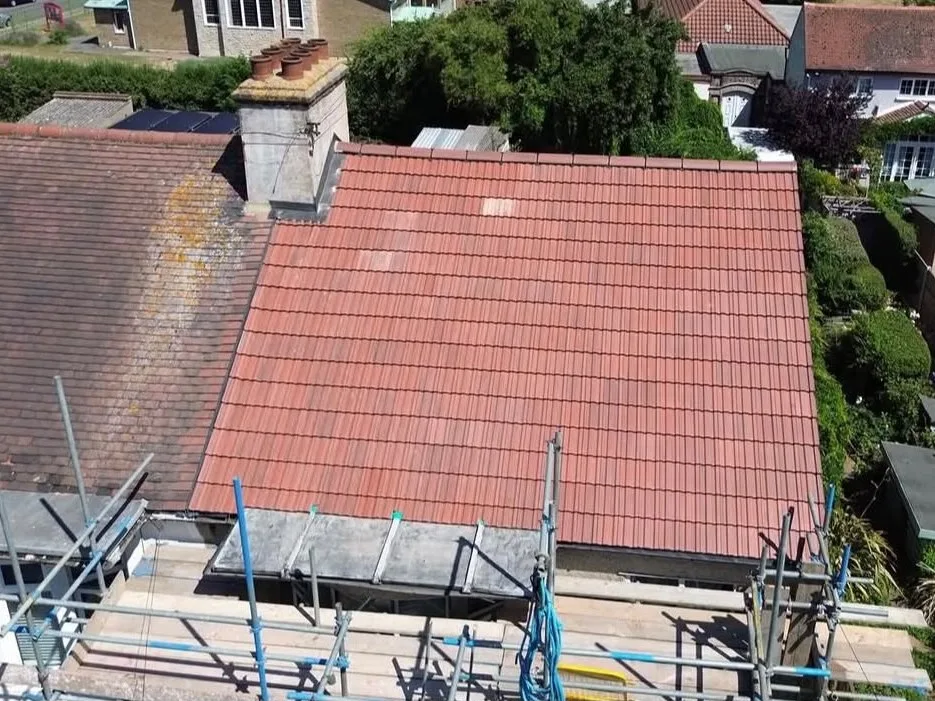
When it is a new roof, the old covering, felt and battens come off, the timbers are checked and repaired while they are exposed, and a breathable membrane goes on under new treated battens. Ridges and verges are fixed mechanically rather than bedded in mortar, which is the detail that fails first on the estate roofs around the town. Scaffold, skip and clearing up are part of the written quote.
Where to go next in Dereham
For a full roof replacement or re-cover, see new roofs in Dereham. For leaks, slipped pantiles and cracked verges, see roof repairs in Dereham. If the problem starts at the edge of the roof, our fascias, soffits and guttering page covers boards and gutters, and roof cleaning and moss removal covers heavy moss on older concrete tile.
Our services in Dereham
Recent work near Dereham
Roofing in Dereham: your questions
How much does a new roof in Dereham cost?
It depends on the size of the roof, the covering, how much of the existing tile can be reused and what the timbers are like underneath. We do not guess a figure over the phone. We survey, then give you a free written quote with the specification set out, so you can compare it properly.
Do I need planning permission to replace my roof in Dereham?
Replacing a roof like for like on a house outside the conservation area does not usually need planning permission. Inside the Dereham Conservation Area, or on a listed building, it may. A full re-roof also has to meet Building Regulations, and we carry it out to current Building Regulations and British Standards.
Do you cover the villages around Dereham as well as the town?
Yes. We work across NR19 and NR20, in the town itself and in the villages around it. A cottage in a village gets the same survey, the same photographs of what we find and the same free written quote as a house in the middle of Dereham.
Is it worth replacing the fascias and gutters at the same time as the roof?
Often, yes. The scaffold is already up, and on a house of the 1960s or 1970s the original boards are usually at the end of their life too. We look at them at survey, so you can decide with the price in front of you.
Ready to get started?
Tell us about your project and we'll be in touch.